Sunlight can bring an outdoor space to life, yet over time it quietly tests the lightfastness of every fabric it touches. A sofa once defined by refined, carefully selected colours may gradually fade, lose its visual consistency, and weaken the overall aesthetic of the project.
For hotels, resorts, beach clubs, and premium outdoor developments, premature fading is more than a visual concern. It can lead to shorter replacement cycles, higher maintenance costs, operational disruption, and a direct impact on the brand experience.
Fabric selection should therefore go beyond colour, texture, and hand feel. Buyers need a clear understanding of Lightfastness and UV Testing — two essential considerations when assessing how well a textile can retain its colour and performance under prolonged exposure to light.
What Do Lightfastness and UV Testing Mean for Buyers?
A fabric lightfastness test evaluates how well a textile retains its colour when exposed to a controlled artificial light source designed to represent natural daylight. The result indicates the degree of colour change observed after a defined exposure—not how many years the fabric will remain unchanged in real-world conditions.
Why is ultraviolet radiation such a concern? Over time, UV exposure can trigger chemical changes in colourants and textile materials. Unlike a stain or tear that appears immediately, fading often develops gradually. A fabric may retain its appearance for months before suddenly beginning to look dull, uneven, or prematurely aged.
For outdoor furniture exposed to intense sunlight and changing weather conditions throughout the year, lightfastness is more than a secondary specification. It is an important indicator of the product’s long-term visual performance.
One distinction is essential: UV resistance in outdoor fabric is a broader concept that may also include changes in fibre strength, surface condition, and other physical properties caused by UV exposure. This article focuses specifically on colour performance—also known as colorfastness to light.
How to Read Lightfastness Rating Systems
For North American specifications and many international hospitality projects, AATCC TM16.3 is one of the recognised methods used to determine the lightfastness of textiles through controlled xenon-arc exposure.
However, the method name alone does not tell the full story. A test result should always be read alongside its exposure conditions, duration or endpoint, test option, and evaluation method.
One commonly used tool for visually assessing colour change after a colorfastness test is the Grey Scale for Color Change.
How to Interpret Grey Scale Ratings
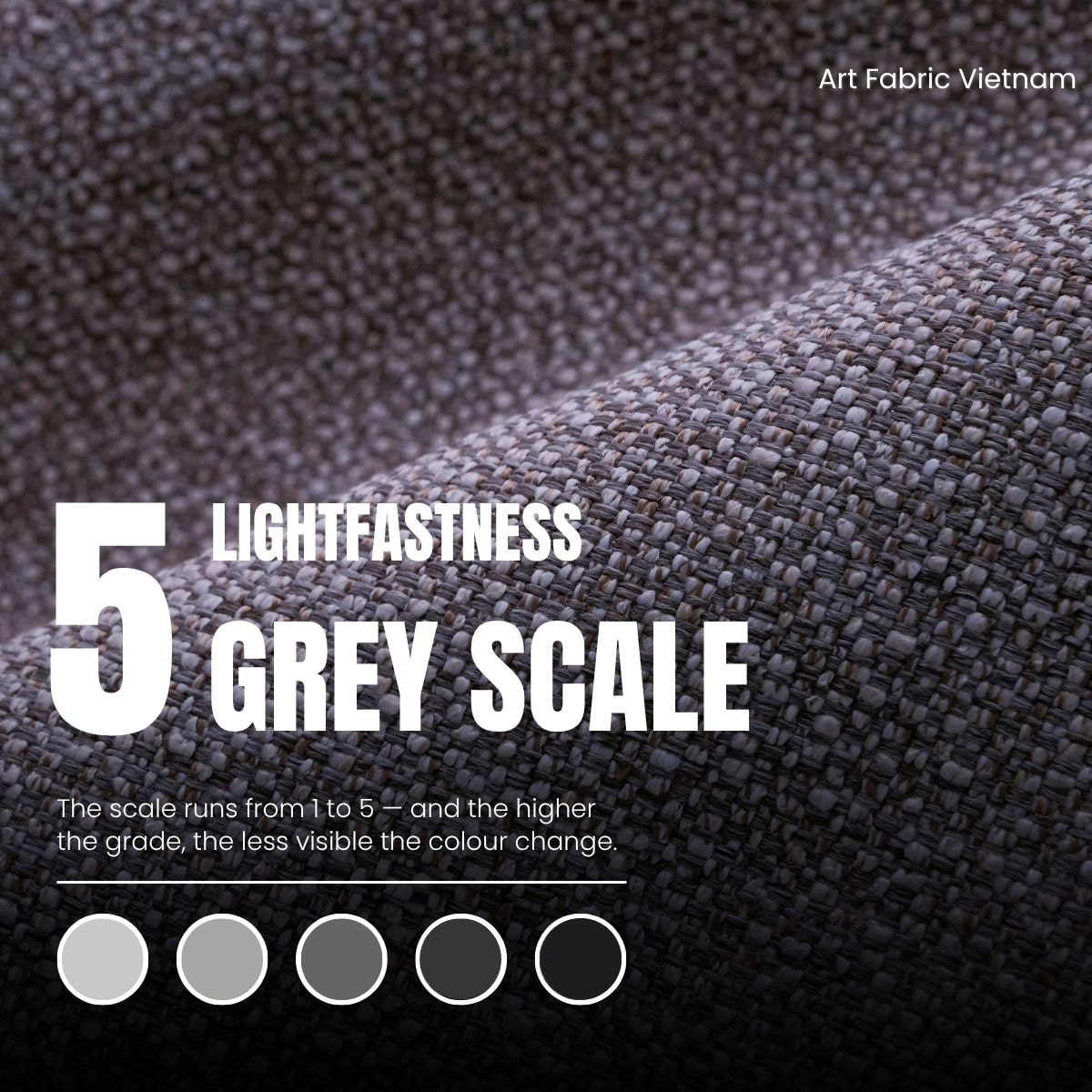
The Grey Scale uses ratings from 1 to 5, including intermediate grades such as 4.5 or 3.5. Depending on the reporting convention, these may also appear as 4–5 or 3–4.
A higher grade indicates less visible colour change after the specified test. It does not, by itself, represent the fabric’s complete UV resistance or guarantee performance in every outdoor environment.
| Grey Scale Rating | Appropriate Interpretation |
| 5 | No colour change observed according to the evaluation scale |
| 4-5 | Very slight colour change |
| 4 | Slight colour change |
| 3-4 | Colour change becomes more noticeable |
| 3 | Noticeable colour change |
| 2 | Significant colour change |
| 1 | The greatest colour change represented by the scale |
Under AATCC Evaluation Procedure 1, the Grey Scale is used to visually assess the overall colour change resulting from colorfastness tests. Grade 5 represents no observed change according to the scale, while Grade 1 represents the greatest degree of change.
It is important to remember that the Grey Scale is an evaluation tool, not the light-exposure test method itself. Buyers should therefore avoid reading a Grey Scale grade without also checking the test method, exposure conditions, duration, and acceptance criteria specified for the project. The ISO system defines its own grey scale for assessing colour change in ISO 105-A02.
ISO 105-B02 Xenon Test
When suppliers claim a fabric is “lightfastness tested,” they are predominantly referring to the ISO 105-B02 xenon test. This international standard utilizes a xenon-arc lamp to accurately simulate natural daylight (D65), operating under the current ISO 105-B02:2014 version.
The Critical Limitation: For outdoor buyers, this standard has a major blind spot—it strictly simulates light, completely ignoring the reality of rain, morning dew, or tropical humidity.
For resort projects fully exposed to the elements, specifiers should mandate the ISO 105-B04:2024 standard. This recently updated artificial weathering framework (Edition 5, 03/2024) combines xenon exposure with rigorous wet and water cycles. The performance gap a single fabric exhibits between the B02 and B04 tests reveals the unvarnished truth about the resilience of its dye.
Navigating the US Market: If you are exporting to the United States, test reports will typically follow AATCC TM16.3. This is the American xenon-arc method featuring three operating options, measured in AFU (Accelerated Fading Units, commonly in multiples of 20) and meticulously graded on the 1–5 Grey Scale.
Why UV Test Hours Should Not Be Compared in Isolation
Suppose a supplier pitches two fabric options for your project: Fabric A claims 1,500 UV hours, while Fabric B boasts an impressive 2,000 UV hours. The natural buyer’s reflex is to instantly conclude that Fabric B offers superior weather resistance.
However, in the world of B2B outdoor procurement, locking in a budget based solely on these superficial numbers is a highly risky decision. To accurately evaluate a material’s true survival capability, buyers must weigh at least three core factors:
- Testing Method: Are both fabrics being tested under the exact same international standard (such as AATCC 16 or ISO 105-B02)? Cross-comparing results from different testing methodologies is nothing more than comparing apples to oranges.
- Testing Conditions: Even if they share the same testing method, are the input parameters identical? Buyers must meticulously review the radiation source used, the test chamber’s temperature, humidity levels, and the wet/dry cycles (such as rain and salt fog simulations).
- Post-Test Results: The sheer number of exposure hours matters far less than one critical question: To what extent did the color actually change after that time? If Fabric B plummets to a severe Grade 2 (significant color shift) after 2,000 hours, it completely loses out to Fabric A, which solidly maintains a Grade 4 (very slight shift) at the 1,500-hour mark.
The Bottom Line: A “UV hours” claim is practically meaningless unless it is comprehensively analyzed alongside the testing method, simulation conditions, and final grading results.
Solution-Dyed
The root cause of why most conventional fabrics succumb to ultraviolet radiation lies in traditional surface-dyeing methods. For commercial-grade colour fastness, one of the most reliable routes is Solution-Dyed technology.
During the solution-dyeing process, color pigment particles are introduced directly into the liquid polymer prior to fiber extrusion. Instead of merely coating color onto the surface (much like the skin of an apple), the color is distributed uniformly throughout the entire core of the fiber (akin to the structure of a carrot).
It is this technology that allows the material to maintain its vibrant appearance even when continuously exposed to UV rays, chlorinated water, and specialized cleaning agents.
Solution-Dyed vs Piece-Dyed
The dyeing method can influence the colour performance of an outdoor textile, but it should never be treated as a performance guarantee. Lightfastness depends on several factors, including the fibre, colourant, construction, finishing process, colourway, and testing conditions.
| Evaluation Criteria | Solution-Dyed Fabric | Piece-Dyed Fabric |
| Colorfastness to Light | Excellent (Grade 4–5) | Fair to Poor (Grade 1–2) |
| UV Resistance | Pigments are embedded within the fiber core, preventing molecular breakdown. | Surface-level color is prone to rapid oxidation and fading. |
| Optimal Application | Sun loungers, fully exposed cabanas. | Decorative indoor pillows, interior waiting areas. |
Solution-dyed textiles can offer a valuable advantage for demanding outdoor projects, but they are not automatically fade-proof. Similarly, piece-dyed fabrics should not be dismissed as suitable only for indoor use.
Outdoor Fabric Solutions from Art Fabric Vietnam
At Art Fabric Vietnam, our outdoor fabric collections—featuring Olefin, Polyester, Recycled Polyester, and blended materials—are specially developed for demanding applications: ranging from Cabana sofas, decorative cushions, and loungers to parasols and general outdoor upholstery.
For large-scale B2B projects, our core working rule is: Never start with the question, “Which fabric has the highest UV hours?”
Instead, the optimal strategy is to first determine the actual operational environment, the intensity of sunlight exposure, and the specific technical requirements of the design. Through this lens, Lightfastness indices, UV Testing reports, and other relevant metrics can be accurately cross-referenced to select the most flawless upholstery format.